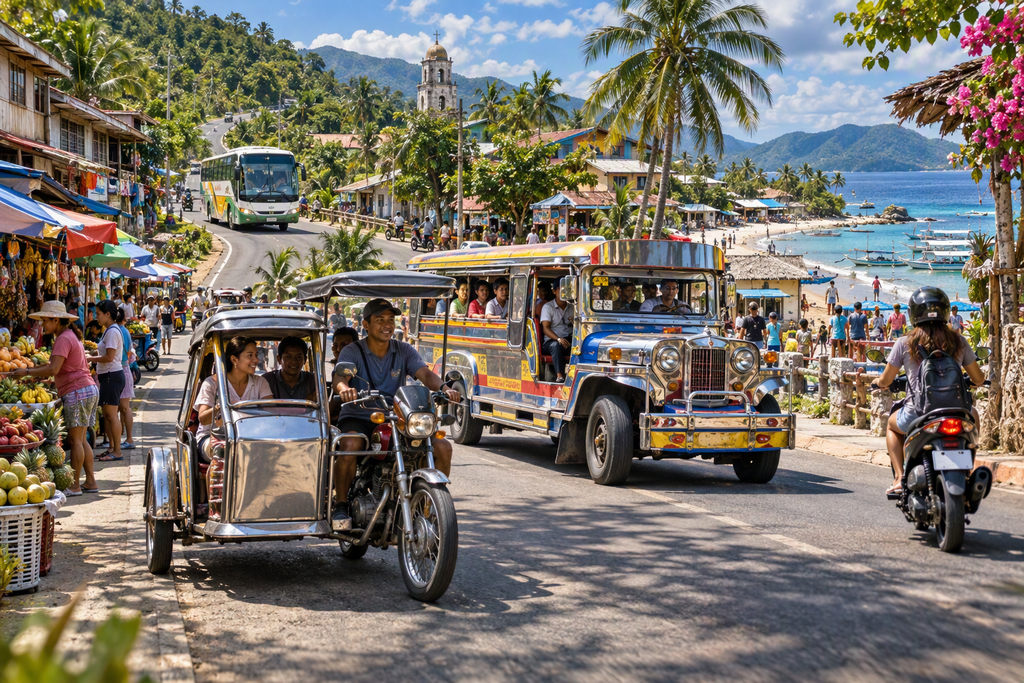
Learn how local transportation works in the Philippines, including tricycles, jeepneys, scooters, taxis, Grab, UV Express vans, and motorcycle taxis. Compare costs, speed, availability, and travel tips.
Traveling by Tricycle, Jeepney, Scooter & Other Local Transportation in the Philippines
After arriving in the Philippines by airplane, ferry, bus, or private vehicle, travelers quickly discover that local transportation works differently than in many other countries.
Understanding the difference between point-to-point transportation and route-based transportation is one of the most important lessons for first-time visitors.
Most local transportation in the Philippines falls into one of these two categories:
Point-to-Point Transportation
Transportation that takes you directly to your destination.
Examples:
- Tricycles
- Taxis
- Grab
- Motorcycle Taxis
- Rental Vehicles
Route-Based Transportation
Transportation that follows a fixed route.
Examples:
- Jeepneys
- UV Express Vans
- Local Buses
- Provincial Buses
A simple rule:
Tricycle = You choose the destination.
Jeepney = You choose the correct route.
Transportation Availability by Location
| Transportation | Major Cities | Provincial Cities | Towns | Rural Areas | Tourist Islands |
|---|---|---|---|---|---|
| Tricycles | Very Common | Very Common | Very Common | Very Common | Very Common |
| Jeepneys | Very Common | Very Common | Common | Common | Varies |
| Taxis | Common | Limited | Rare | Rare | Rare |
| Grab | Common | Limited | Rare | Rare | Rare |
| Motorcycle Taxis | Common | Limited | Rare | Rare | Rare |
| UV Express Vans | Common | Common | Common | Limited | Varies |
| Provincial Buses | Common | Common | Common | Common (Along Highways) | Limited |
| Scooter Rentals | Limited | Common | Common | Common | Very Common |
| Rental Cars | Common | Common | Limited | Limited | Common |
Tricycles: The Everyday Transportation Option
Across the Philippines, tricycles are the most common form of transportation and are often the default choice for local travel. For many Filipinos, a tricycle is the first transportation option considered for short local trips, serving much the same role that taxis serve in other countries.
Unlike jeepneys, buses, and UV Express vans, tricycles generally provide point-to-point transportation. You simply tell the driver where you want to go, and the driver takes you there.
Common Uses
- Bus Terminal → Hotel
- Downtown → Hotel
- Hotel → Restaurant
- Market → Home
- Ferry Port → Resort
- Resort → Beach
- Attraction → Downtown
- Friend’s House
- Barangay Visits
In most locations, tricycles can be found near:
- Markets
- Downtown districts
- Malls
- Resorts
- Transportation terminals
- Beaches
- Commercial areas
Typical Costs
| Trip Type | Typical Cost |
|---|---|
| Very Short Ride | ₱15–₱30 |
| Short Local Ride | ₱30–₱80 |
| Cross-Town Ride | ₱80–₱150 |
| Longer Private Ride | ₱150–₱500+ |
Actual prices vary by destination and distance.
Tricycles for Travelers
| Traveler Type | Suitability |
|---|---|
| Solo Traveler | Excellent |
| Couple | Excellent |
| Couple with Luggage | Excellent |
| Family | Good |
| Group Outing | Multiple Tricycles |
| Resort Trip with Supplies | Multiple Tricycles |
Many first-time visitors underestimate what tricycles can handle. It is common to see families, luggage, groceries, coolers, food, and supplies transported by multiple tricycles traveling together.
Tricycle Travel Tip
If traveling to a remote attraction such as a waterfall, beach, viewpoint, or trailhead, always ask:
- Is transportation available back to town?
- Should I arrange a pickup?
- Can the driver return later?
Never assume transportation will be waiting when you’re ready to leave.
Taxis
Taxis are primarily found in:
- Metro Manila
- Clark and Angeles
- Baguio
- Cebu City
- Davao City
- Other larger cities
Taxis are useful for:
- Airport transfers
- Larger luggage loads
- Comfortable transportation
- Travelers unfamiliar with the area
Typical Costs
| Trip Type | Typical Cost |
|---|---|
| Short Ride | ₱80–₱250 |
| Cross-City Ride | ₱250–₱800+ |
| Airport Transfer | ₱250–₱1,500+ |
Grab
Grab is the most popular ride-hailing application in the Philippines.
Best For
- Airports
- Hotels
- Tourists
- Cashless payments
- Travelers unfamiliar with local routes
Advantages
- Fixed pricing
- GPS navigation
- Cashless options
- Reduced language barriers
Motorcycle Taxis
Motorcycle taxi services are available in larger urban areas.
Popular services include:
- Angkas
- JoyRide
- Move It
Best For
- Rush hour traffic
- Urban transportation
- Solo travelers
Typical Costs
| Trip Type | Typical Cost |
|---|---|
| Short Ride | ₱50–₱150 |
| Longer Ride | ₱150–₱300+ |
Jeepneys
Jeepneys are one of the most common forms of route-based transportation in the Philippines. Unlike tricycles, jeepneys do not take passengers directly to a requested destination. Instead, they operate along fixed routes connecting markets, malls, transportation terminals, downtown districts, schools, universities, and residential neighborhoods.
How Jeepneys Work
The jeepney already knows where it is going.
Your job is to determine whether your destination is along that route.
Most jeepneys display their route on signs located:
- In the front windshield
- Near the driver
- Near the front passenger entrance
If you are unsure whether the jeepney serves your destination, ask the driver or another passenger before boarding.
Paying Your Fare
Paying for a jeepney ride is a uniquely Filipino experience.
- Ask the fare if you are unsure.
- Prepare small bills or coins whenever possible.
- Hand your fare to the passenger nearest the driver.
- Other passengers will pass the money forward until it reaches the driver.
- Any change is returned the same way and passed back through the passengers to you.
It is completely normal for strangers to pass money and change throughout the vehicle.
Carry Small Bills and Coins
For jeepney travel, always try to carry:
- ₱20 bills
- ₱50 bills
- ₱100 bills
- Coins
Small denominations make transactions easier for everyone.
Knowing When to Get Off
Jeepneys do not announce stops.
There are:
- No automated stop announcements
- No digital displays
- Usually no route maps onboard
Passengers are expected to know where they are going and when they need to get off.
Helpful options include:
- Following your route on Google Maps
- Watching for landmarks
- Asking another passenger
- Telling the driver where you are going before departure
Waiting for Departure
Along busy routes, jeepneys continuously pick up and drop off passengers.
However, at:
- Public markets
- Malls
- Transportation terminals
- Downtown loading areas
a jeepney may wait until enough passengers have boarded before beginning the route.
Typical Costs
| Trip Type | Typical Cost |
|---|---|
| Short Local Ride | ₱13–₱20 |
| Longer Local Ride | ₱20–₱50+ |
Best For
- Budget travelers
- City transportation
- Local transportation
- Traveling like a local
UV Express Vans
UV Express vans provide fast route-based transportation between cities, municipalities, and transportation hubs.
Advantages
- Faster than buses
- Direct routes
- Comfortable seating
- Common in tourist regions
Disadvantages
- Less luggage space
- Often wait for passengers before departing
- Limited legroom
Typical Costs
| Trip Type | Typical Cost |
|---|---|
| Regional Trips | ₱50–₱400+ |
Scooters & Personal Transportation
Scooter rentals are one of the most popular transportation options in many tourism destinations.
Best For
- Solo travelers
- Couples
- Island exploration
- Beach destinations
- Multi-day stays
Popular Destinations
- Siargao
- Siquijor
- Camiguin
- Bohol
- Bantayan Island
- Puerto Galera
- Coron
- El Nido
Typical Costs
| Rental Period | Typical Cost |
|---|---|
| Per Day | ₱300–₱800+ |
Always comply with local traffic regulations and licensing requirements.
Shared vs Private Transportation
Many transportation services in the Philippines operate as either shared transportation or private transportation.
Shared Transportation
Common examples include:
- Jeepneys
- UV Express Vans
- Local Vans
- Some Tricycles
Shared transportation is generally the cheapest option.
Private Transportation
Can often be arranged for:
- Tricycles
- Vans
- Multicabs
- Some Jeepneys
Travel Tip
If there are only a few empty seats remaining in a van or shared vehicle, ask whether you can pay for the remaining seats and leave immediately.
For couples, families, and small groups, the extra cost is often worth the time saved.
Cash, Coins & Small Bills
One of the easiest ways to avoid transportation headaches is to carry small bills and coins.
Recommended
- ₱20 bills
- ₱50 bills
- ₱100 bills
- Coins
Useful for:
- Tricycles
- Jeepneys
- Public comfort rooms
- Small stores
- Entrance fees
- Snacks and drinks
Practical Advice
The farther you travel from airports, malls, downtown districts, and major transportation hubs, the more important small bills and coins become.
Fastest Transportation by Situation
| Situation | Best Choice |
|---|---|
| Going to a Specific House or Address | Tricycle |
| Downtown to Hotel | Tricycle |
| Downtown to Restaurant | Tricycle |
| Market to Home | Tricycle |
| Ferry Port to Accommodation | Tricycle |
| Airport to Hotel | Grab |
| Heavy Luggage | Taxi or Grab |
| Beating City Traffic | Motorcycle Taxi |
| City to Nearby Town | UV Express Van |
| Province to Province | Provincial Bus |
| Exploring an Island | Scooter |
| Family Vacation | Rental Car or Van |
| Remote Attraction | Tricycle or Pre-Arranged Driver |
Ask a Local
One of the easiest ways to solve transportation questions in the Philippines is simply to ask someone.
Whether you’re looking for:
- Tricycle availability
- Jeepney routes
- Bus schedules
- Van departure locations
- The nearest terminal
- Transportation to an attraction
- Return transportation
simply ask.
Hotel staff, tricycle drivers, market vendors, store owners, terminal staff, and local residents often know the answer or can point you in the right direction.
Simple Rule
If you’re unsure how to get somewhere, ask. If you’re unsure how to get back, ask before you leave.
Many travelers focus on reaching their destination but forget to check whether transportation is available for the return trip.
A two-minute conversation can save hours of waiting later.
Final Takeaway
Transportation in the Philippines becomes much easier once you understand the difference between point-to-point transportation and route-based transportation.
- Tricycles take you directly where you want to go.
- Jeepneys follow fixed routes.
- UV Express Vans provide fast regional transportation.
- Scooters offer freedom for independent exploration.
- Grab and Taxis provide convenience in larger cities.
For most travelers, learning when to use a tricycle, when to use a jeepney, and when to simply ask a local for help will make exploring the Philippines significantly easier and more enjoyable.
Related Transportation Guides
National Transportation Guides
- Philippine Transportation Guide
- Philippine Land Transportation Guide
- Philippine Airports Guide
- Philippine Ferry Guide
- Domestic Flights in the Philippines
Regional Land Transportation Guides
- Luzon Mainland Land Transportation Guide (future)
- Luzon Islands Land Transportation Guide (future)
- Visayas Land Transportation Guide (future)
- Mindanao Mainland Land Transportation Guide (future)
- Mindanao Islands Land Transportation Guide (future)
Ferry & Sea Transportation
- Ferry Routes for the Philippines Guide
- Luzon Ferry Guide
- Visayas Ferry Guide
- Mindanao Ferry Guide
- Inter-Island Travel in the Philippines
Road Trip & Self-Drive Guides
- Philippine Road Trip Guide
- Luzon Road Trips Guide
- Visayas Road Trips Guide
- Mindanao Road Trips Guide
Transportation Hubs & Airports
- NAIA Airport Guide
- Clark International Airport Guide
- Mactan-Cebu International Airport Guide
- Davao International Airport Guide
Vacation Planning Guides
- Vacation Planning Guide
- Travel Budgeting Guide
- Travel Costs in the Philippines
- Accommodations in the Philippines
- Island Hopping in the Philippines
Travel Styles
- Travel for Couples in the Philippines
- Travel for Families in the Philippines
- Travel for Solo Travelers in the Philippines
- Travel for Seniors in the Philippines (future)